_1788326706.webp)
Shochu vs. Soju: Unravelling the Secrets of Asia's Iconic Spirits
2026-09-02
.png)
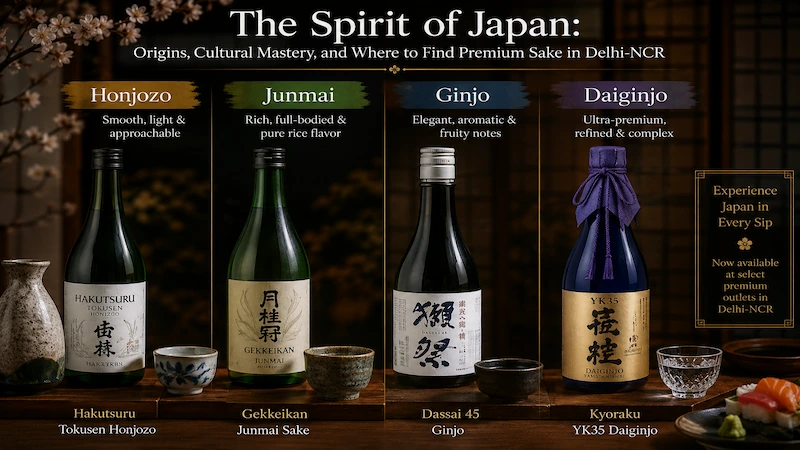
Sake is Japan’s iconic fermented rice beverage, deeply rooted in history, Shinto traditions, and social customs. This guide explores its origins, cultural significance, premium classifications, popular bottles available across Delhi-NCR, food pairings, and serving techniques, helping both newcomers and enthusiasts understand and enjoy premium Japanese sake with confidence.
Often referred to as Japanese rice wine, sake (nihonshu) is technically neither a wine nor a beer. It occupies a distinct space in the world of craft brewing, crafted through a process of simultaneous parallel fermentation where rice starches convert into sugars and alcohol in a single container.
Over the past decade, Delhi and Gurgaon have experienced a culinary evolution. Driven by an expanding expat community and an increasingly adventurous local palate, Japanese cuisine and premium sake have moved from niche status into the mainstream.
Understanding sake requires looking at its centuries-old heritage, its spiritual significance in Japanese culture, and the premium selections now stocking shelves across the National Capital Region (NCR).
The origins of sake date back over 2,000 years, coinciding with the spread of wet-rice cultivation from mainland Asia to Japan during the Yayoi period (c. 300 BCE – 300 CE).
Early forms of sake were drastically different from today's refined drink. Known as kuchikami no sake (chew-in-the-mouth sake), village members often young maidens would chew raw rice, chestnuts, or millet and spit the mixture into a communal vat. Enzymes in human saliva acted as the catalyst, breaking down complex starches into fermentable sugars.
By the Nara period (710–794 CE), this primitive method was replaced by the discovery of koji-kin (Aspergillus oryzae), a beneficial mold spore. When dusted onto steamed rice, koji breaks down rice starch into sugar far more cleanly and efficiently. The Imperial Court established a dedicated brewing department (Sake no Tsukasa), formalizing sake production and turning it into a refined art form.
During the Edo Period (1603–1867), master brewers (toji) perfected multi-stage batch fermentation, water purification, and seasonal brewing methods. This laid the foundation for modern classifications based on seimai-buai (the rice polishing ratio).
In Japan, sake is far more than a beverage; it is a sacred bridge between human communities and the spiritual world. (Fostering Harmony)
Shinto Traditions: Sake plays an integral role in Shinto worship. Brewed as an offering to the kami (spirits or gods), consecrated sake is known as Omiki. During traditional Shinto weddings, the couple performs the San-san-kudo (three-three-nine-times) ritual, taking three sips of sake from three different-sized wooden or ceramic cups (sakazuki) to formalize their marital bond.
Seasonal Celebrations: Sake mirrors the rhythm of Japanese seasons. Spring brings Hanami-zake (enjoying unfiltered or fresh sake beneath blooming cherry blossoms), while winter calls for Yukimi-zake (warmed sake enjoyed while watching falling snow).
The Etiquette of Connection: In Japanese culture, one rarely pours their own sake. Tejaku (self-pouring) is considered poor etiquette in social settings. Instead, dining partners pour for one another an exchange known as osake o tsugu which fosters respect, attentiveness, and social harmony.
When browsing high-end bottles, sake quality is primarily categorized by how much the raw rice grain has been polished down to remove outer fats and proteins, leaving behind pure starch at the core:
|
Grade |
Rice Polishing Ratio (Seimai-buai) |
Flavor Profile |
|---|---|---|
|
Honjozo |
At least 30% polished off (≤70% grain remaining) |
Crisp, light, easy-drinking, slightly savory |
|
Junmai |
No minimum, but zero added alcohol |
Rich, full-bodied, earthy with strong rice aroma |
|
Ginjo |
At least 40% polished off (≤60% grain remaining) |
Fragrant, floral, fruity, refined |
|
Daiginjo |
At least 50% polished off (≤50% grain remaining) |
Complex, silky, ultra-smooth, delicate sweetness |
With fine dining hubs like Horizon Centre in Gurgaon and luxury retail hubs across Delhi, access to authentic Japanese imports has never been better. High-end retail outlets such as G-Town Wines and L'Opera Spirits in Gurgaon, or boutique alcohol stores in Delhi’s South Extension and Khan Market frequently stock these sought-after labels:
Origin: Hyogo Prefecture
Profile: Brewed using Yamada Nishiki often dubbed the "King of Sake Rice" this bottle delivers a balanced blend of full-bodied taste and a clean, dry finish.
Best Paired With: Grilled yakitori, chicken teriyaki, or rich Indian tandoori starters.
Availability: Widely available across major Gurgaon luxury liquor hubs and premium Delhi retail shops.
Origin: Nada, Hyogo Prefecture
Profile: A flagship example of master brewing, Hakutsuru Dai-Ginjo is polished down to 50% or less. It presents a floral nose with hints of green apple, melon, and anise, finishing silky-smooth on the palate.
Best Paired With: Fresh sashimi, black cod miso, or light carpaccio. Serve chilled.
Availability: Stocked at select high-end wine and spirits emporiums across NCR.
Origin: Hyogo Prefecture
Profile: Known for its rich aromatic nose ("Kaon" translates to fragrance), this mid-tier to premium sake delivers gentle sweetness balanced by clean acidity. It is accessible for newcomers while maintaining depth for seasoned drinkers.
Best Paired With: Tempura, sushi rolls, and delicate pan-Asian appetizers.
Availability: Available at major retail chains in Gurgaon.
Origin: Saitama Prefecture
Profile: Aged in traditional Yoshino cedar barrels (taru), this sake picks up distinct woody aromas, spicy cedar notes, and a clear, refreshing structure.
Best Paired With: Robatayaki, savory hot pots, and rich grilled meats.
Availability: Found at specialty Japanese stores and boutique liquor outlets catering to expat hubs in Gurgaon.
To experience your bottle at its best:
Whether enjoyed alongside sushi at a restaurant in CyberHub or poured at home from a freshly acquired bottle, sake offers a direct taste of Japanese craftsmanship and culture.
_1785317074.webp)